
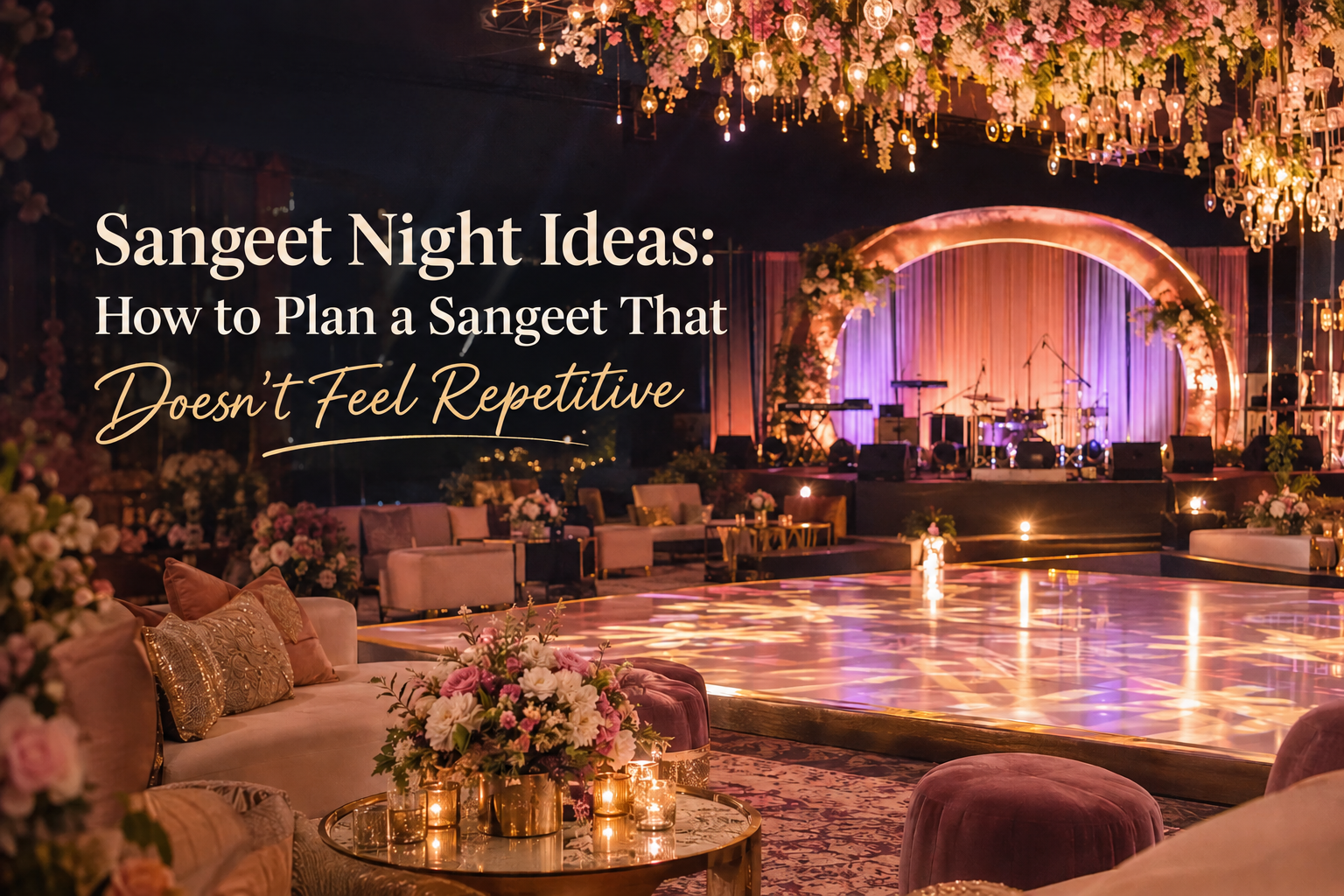
Almost every sangeet in Delhi NCR follows the same script: a welcome dance, four or five family performances, a DJ set after 10 pm, and a stage nobody really uses after the choreography ends. Guests know the format before they arrive. That’s the actual problem couples are trying to solve when they say they want their sangeet to feel “different” — not a bigger stage or a louder speaker, but an evening that doesn’t play out exactly like the one they attended last month.
As a wedding event specialist, we treat the sangeet as its own function with its own planning logic not a smaller version of the wedding day.
A sangeet that stands out isn’t built on one big surprise. It’s built on small decisions how the night opens, how performances are sequenced, how the space is used, and where guests are given something to actually do instead of just watch. Here’s how to plan one that people remember for the right reasons.
What Makes a Sangeet Feel Repetitive in the First Place
Before changing anything, it helps to know what’s causing the sameness:
– The same opening every time. A formal welcome followed immediately by the first family act, with no build-up.
– Performances with no arc. Five dances in a row, all roughly the same energy, back to back.
– One flat stage for the whole night. No change in setting between the ceremony-style segment and the party segment.
– Guests as an audience, not participants. Everyone sits and watches until the dance floor opens at the very end.
– Décor that matches every other sangeet post on Instagram. Fairy lights and a phool-mala backdrop, without anything specific to the couple.
Fixing even two or three of these changes how the evening is remembered. If you’re mapping this against your full celebration, our wedding planner in Delhi NCR guide is a useful starting point before you get into individual functions.
1. Design the Evening in Segments, Not Just a Performance List
Instead of treating the sangeet as one long performance block, split it into three distinct segments with their own mood:
-Arrival and welcome – lighter music, a curated entry moment for the couple, no big reveal yet.
–The performance segment – family and friends’ acts, sequenced by energy rather than by who asked first (open with something warm, place the highest-energy act toward the middle, close performances on an emotional note rather than the loudest one).
-The open segment – DJ, live band, or a crossover set where the stage opens up and guests move from watching to participating.
This structure alone removes the flat, one-note feel most sangeets have.
2. Rethink the Entry – It Sets the Tone for Everything After
The couple’s entry is usually the first thing guests actually watch closely, so a generic entrance sets a generic tone for the rest of the night. A few directions worth considering, depending on venue and budget:
-A live acoustic or instrumental moment instead of a recorded track, timed to the couple walking in.
-Staggered entries – bride and groom entering separately through different points in the venue, with the room’s attention shifting rather than staying fixed on one spot.
-A short storytelling visual (photos, a short film, or a live narrator) that plays just before the entry, giving guests context instead of a cold start.
3. Use the Stage Differently for Different Segments
Most sangeet stages are static one backdrop, one setup, for the entire night. Reconfiguring lighting and staging between segments (for example, warmer, softer lighting for family performances and a shift to a more dynamic lighting design once the floor opens) signals a change in mood without needing a second venue or a big reveal. This is a décor and production decision, not an additional cost centre if planned early with your décor and lighting vendors see how we approach this as part of our wedding and event services.
4. Sequence Performances With Intention
Ask every performing group two questions before the night: what song, and what energy level. Then sequence accordingly:
-Open with a warm, inclusive act (something with older family members, if they’re performing) rather than the highest-energy group.
-Place comedic or theatrical acts in the middle, where attention naturally dips.
-Close performances on one emotional or meaningful act this could be a parents’ dance, a childhood-photo montage set to music, or a couple’s own performance before handing the floor to open dancing.
This single change in sequencing is one of the most effective and least expensive ways to make a sangeet feel intentional.
5. Give Guests Something to Do, Not Just Watch
A sangeet that stays interesting past 11 pm usually has moments guests can participate in, not just performances to watch:
– Interactive food stations guests can move between instead of a single buffet line.
– A guess-the-couple or memory-based interactive segment worked into the transition between performances and open dancing.
– Photo or video moments designed into the décor a specific corner or backdrop guests want to use, rather than a generic step-and-repeat.
6. Choose a Theme That’s Personal, Not a Trend
“Bollywood retro” and “neon night” are popular because they’re easy, not because they’re distinctive. A theme rooted in something specific to the couple a shared interest, a place that matters to the family, a colour story that runs through the wedding rather than existing only for one night reads as intentional even when the execution is simple. For couples planning their sangeet as part of a destination celebration, this theme can also tie into the destination itself browse our destination wedding planning in Delhi NCR page for how we approach that. You can also see real staging and décor setups from past celebrations in our gallery.
Planning a Sangeet That Feels Like Yours
A sangeet doesn’t need a bigger budget to feel different it needs a plan that treats the evening as an experience with a beginning, middle and end, not just a list of performances. That’s the part most families don’t have time to design themselves while also managing the rest of the wedding.
Dream Lamhe plans sangeet nights as part of complete wedding celebrations across Delhi NCR from staging and décor to performance sequencing, vendor coordination and on-ground event logistics so the evening feels considered from the first entry to the last dance.
Planning your sangeet or full wedding celebration? Book a Free Consultation with Dream Lamhe to start designing a night that doesn’t look like everyone else’s.
Related Function Guides
Explore more planning guides on the Dream Lamhe blog
Frequently Asked Questions
How far in advance should sangeet planning start?
For a sangeet with choreographed performances, décor customisation and vendor coordination, most families begin serious planning 2–3 months before the wedding date, with performance rehearsals starting around 4–6 weeks out.
What is a realistic budget range for a sangeet in Delhi NCR?
Sangeet budgets vary widely based on venue, décor scale, production (lighting/sound) and entertainment choices. As part of an overall wedding budget, most premium Delhi NCR sangeets are planned within the broader wedding budget rather than as an isolated cost, so it’s worth discussing this alongside your total wedding planning budget with your planner.
Do I need a choreographer for every family performance?
No. A choreographer is useful for the couple’s own performance or a large group act, but many of the most memorable moments come from unchoreographed, genuine family performances. Mixing both usually works better than choreographing everything.
Can a sangeet be combined with the cocktail function?
Yes, many Delhi NCR families now combine the sangeet and cocktail party into a single evening to reduce the number of separate functions, particularly for smaller guest lists. This needs careful segment planning so the night doesn’t feel rushed or overloaded.
What's the most common mistake families make when planning a sangeet?
Treating the stage and performance list as the entire plan, while leaving décor, transitions, lighting changes and guest experience as an afterthought. The performances matter, but the segments in between are what guests actually remember.