
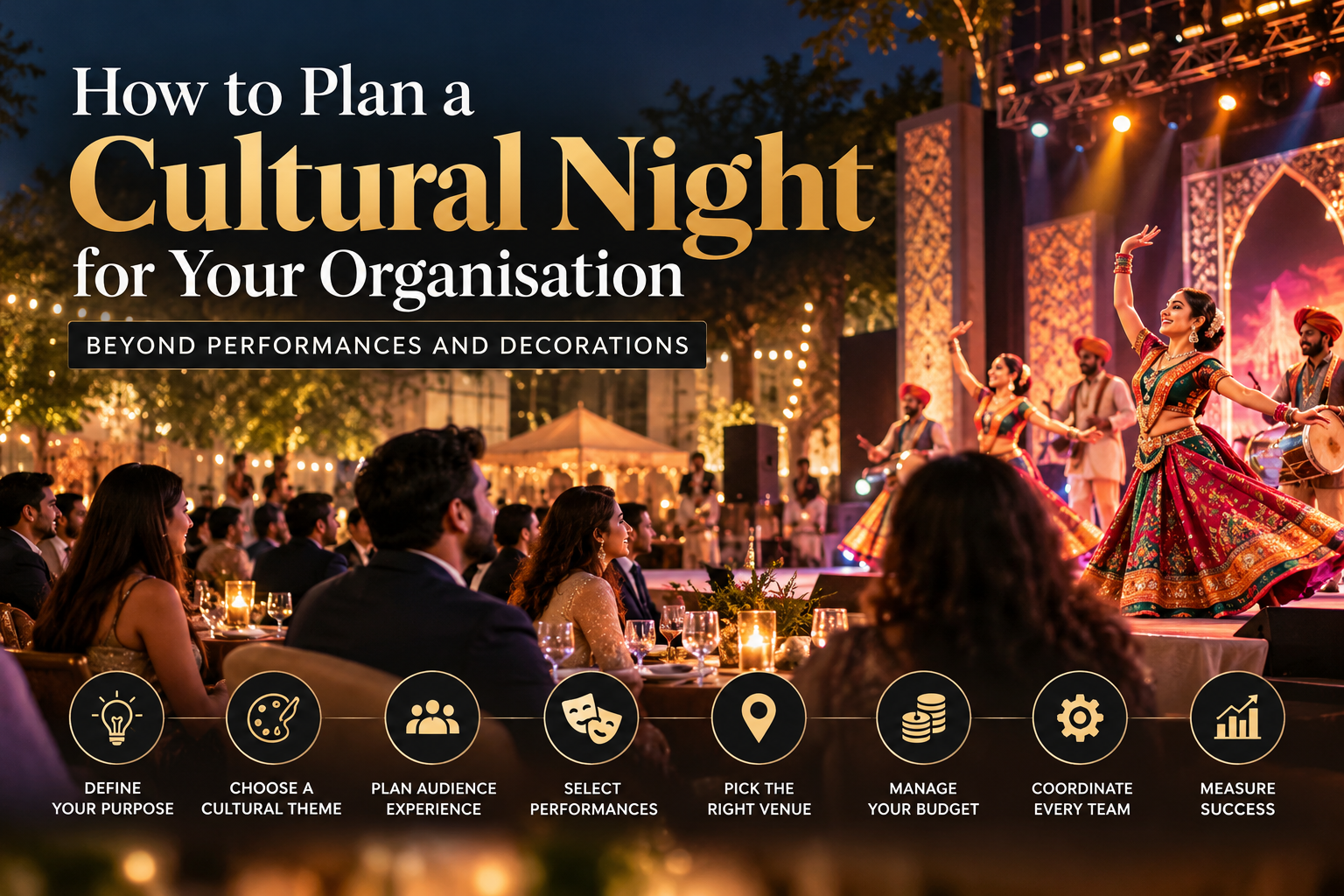
A cultural night is more than an evening of music, dance, and entertainment. It is an opportunity for an organisation to bring people together, celebrate diversity, encourage participation, and create experiences that employees, guests, and partners can remember. Whether it is a corporate cultural evening, an annual celebration, or an inter-departmental gathering, thoughtful planning can turn an ordinary event into a meaningful experience.
However, organising a successful cultural night requires more than choosing performances and booking a venue. From selecting the right theme and coordinating artists to managing technical arrangements and creating a smooth event schedule, every detail contributes to the overall experience.
With the right approach to cultural night event planning, organisations can create an engaging celebration that reflects their values, encourages interaction, and keeps guests entertained throughout the evening.
Start With One Question: What Should Guests Remember?
Before selecting a theme, identify what the organisation wants people to take away from the evening.
If the purpose is employee engagement, the programme should give employees opportunities to participate rather than simply watch from their seats. If the event celebrates regional diversity, the performances, food, storytelling, and visual elements should represent that idea consistently. If the cultural night is part of an annual corporate celebration, the programme might combine cultural performances with employee recognition and a shared celebration.
This decision matters because the same event format will not work equally well for every audience.
For example, a company with employees from several Indian states might build its evening around regional traditions, with each segment introducing a different art form or cultural practice. A smaller organisation might prefer an informal cultural showcase with employee-led performances and interactive activities.
The creative concept should follow the purpose of the event, rather than forcing the organisation into a theme that simply looks attractive.
Design the Cultural Theme as a Complete Experience
A cultural theme becomes more effective when it connects the different parts of the event. Choosing a theme such as “Colours of India” is only the starting point. The real planning challenge is deciding how that theme will influence the stage, guest experience, performances, food, and activities.
Consider a cultural evening celebrating India’s regional diversity. The entrance could introduce the theme through regional artwork, the stage programme could feature selected folk traditions, and the food experience could highlight dishes associated with different regions. Short introductions before performances could explain their cultural context without turning the evening into a lecture.
This creates a stronger connection between the elements of the event.
Cultural representation also deserves attention. When selecting music, costumes, visual references, and performances, organisers should avoid treating distinct traditions as interchangeable decorations. Working with knowledgeable artists and explaining the context of a performance can make the programme more respectful and meaningful.
The aim is not to include as many cultural references as possible. It is to select the right elements and present them thoughtfully.
Plan the Audience Experience Between Performances
The gaps between performances are often overlooked during planning. Yet these transitions can influence how the evening feels just as much as the main acts.
Imagine a dance performance ending, followed by several minutes of stage rearrangement while guests wait for the next act. Even a strong performance can lose its impact if the following segment takes too long to begin.
A better approach is to plan transitions alongside the performances themselves.
The event team can prepare short introductions for the host, confirm stage requirements in advance, arrange performers in the correct sequence, and use suitable background music during planned changes. Where appropriate, an interactive activity or a brief cultural introduction can fill a transition without making the programme feel crowded.
Every segment should have a clear purpose, an expected duration, and a defined handover to the next segment. The programme should also include enough flexibility to accommodate applause, guest interaction, and small delays.
This is where a detailed run-of-show document becomes valuable. Unlike a guest-facing agenda, it records the operational details: who introduces each act, when the music starts, which microphone is required, who prepares the next performers, and who responds if a segment runs late.
Choose Performances for the Audience, Not Just the Stage
An impressive artist or elaborate dance production does not automatically make a programme suitable for every organisation.
The entertainment selection should reflect the audience’s age range, cultural interests, event format, and level of participation. A formal corporate audience may appreciate a carefully curated sequence of live music, dance, and short presentations. A more informal gathering may benefit from employee performances, cultural games, and opportunities for guests to interact.
A useful planning approach is to divide the programme into three categories:
Featured performances: These are the main attractions of the evening, such as a folk dance troupe, live musical performance, or specially commissioned cultural presentation.
Audience participation: These activities invite guests to become involved through cultural quizzes, collaborative art, traditional games, or voluntary employee performances.
Connecting segments: These include host introductions, short stories about cultural traditions, announcements, and transitions that link the programme together.
The balance between these categories depends on the event’s purpose. A performance-focused evening may devote more time to professional artists, while an employee engagement event may place greater emphasis on participation.
The important thing is to avoid creating a programme in which guests are expected to remain passive for the entire evening.
Make Venue Selection a Production Decision
Venue selection is often approached as a question of appearance, location, and guest capacity. For a cultural night, the practical requirements of the programme should influence the decision just as strongly.
A ballroom may be appropriate for a formal evening with a stage, dinner seating, and professional performances. An auditorium may work better when the audience needs a clear view of the stage. An outdoor venue may suit a festival-style event with cultural stalls and interactive spaces, provided that suitable weather contingencies are available.
Before confirming a venue, consider how the audience and production team will use the space.
Will guests have a clear view of the stage from their seats? Is there enough backstage space for performers to prepare and wait? Can the sound system accommodate both spoken introductions and music? Will food service interfere with the performance area? Can guests move comfortably between seating, activity zones, and refreshments?
These questions help reveal problems that may not be obvious during a venue visit.
For organisations in Delhi NCR, travel time, parking arrangements, venue access, and the timing of the event should also be considered. A venue that looks ideal on paper may be less suitable if guests face unnecessary difficulty reaching it or if production access is restricted.
The best venue is the one that supports the intended experience and can accommodate the event’s operational requirements.
Build the Budget Around the Experience
Cultural night budgets can vary significantly depending on the venue, guest count, artist selection, production requirements, and hospitality arrangements. Instead of beginning with a list of attractive options, start by identifying which parts of the experience are essential.
For instance, an event built around live performances may require a greater allocation for artists, sound, lighting, and stage production. A cultural networking evening may place more emphasis on the venue layout, catering, activity areas, and guest interaction.
The budget should account for more than the visible arrangements. Artist transportation, rehearsal time, technical requirements, setup and dismantling, vendor access, and additional staffing can all affect the final cost.
Request detailed quotations and confirm exactly what each supplier will provide. An artist quotation, for example, should clarify performance duration, technical requirements, travel arrangements, and any additional charges. A venue quotation should be reviewed for the facilities and services included.
Maintain a contingency allowance rather than allocating the entire budget to confirmed items. This provides some flexibility if requirements change or unexpected expenses arise.
A well-managed budget is not necessarily the smallest budget. It is one in which spending is connected to the event’s objectives and the organisation understands what it is paying for.
Coordinate Every Team Through One Event Plan
A cultural night often involves several groups working towards the same deadline: the organisation’s internal team, venue representatives, artists, décor suppliers, technical production teams, caterers, and the event coordinator.
If these teams work from different schedules or incomplete information, problems can occur even when each supplier performs their individual role correctly.
A shared event plan should identify the responsibilities of each team, important deadlines, arrival and setup times, rehearsal requirements, and the sequence of activities. The person responsible for each major decision should be clearly identified.
A technical rehearsal or production briefing is particularly useful when the event includes multiple performances, video presentations, live music, or complex stage changes. It gives the team an opportunity to confirm the practical details before the audience arrives.
Contingency planning should also cover likely disruptions. The team should know what happens if a performer is delayed, a presentation fails to play, the programme runs behind schedule, or an outdoor arrangement becomes unsuitable because of weather.
These preparations may never be visible to the audience, but they can make a considerable difference to the overall experience.
Decide How You Will Measure the Event’s Success
A successful cultural night should be evaluated against the reason it was organised.
If employee engagement was the main objective, useful indicators might include attendance, participation in activities, and feedback from employees. If the purpose was to celebrate cultural diversity, feedback could explore whether guests found the programme engaging and informative. For a client-facing event, guest feedback and the quality of the overall hospitality experience may be more relevant.
Organisers can collect feedback through a short post-event survey, review attendance against registrations, and hold a debrief with the internal team and suppliers.
The debrief should identify what worked, where delays occurred, which arrangements required last-minute changes, and what should be improved for the next event.
This turns the cultural night into more than a one-off celebration. It gives the organisation practical information that can improve future events.
When Professional Event Planning Makes a Difference
For a small gathering with a straightforward programme, an internal team may be able to manage the arrangements. However, when an event involves multiple artists, a complex production schedule, several activity areas, external vendors, or a large guest list, coordination can become difficult to manage alongside normal work responsibilities.
Professional event planning support can help connect the creative concept with the operational requirements. This may include venue sourcing, theme development, artist coordination, décor, technical production, hospitality, vendor communication, and on-site execution.
For organisations planning a cultural evening in Delhi NCR, Dream Lamhe can be considered for corporate event planning requirements where coordinated arrangements and a well-managed guest experience are important.
You can explore the corporate event planning services offered by Dream Lamhe to learn more about the available support.
The appropriate level of assistance will depend on the size, complexity, and objectives of the event.
Final Thoughts
The difference between a collection of performances and a memorable cultural night lies in how the experience is designed and delivered.
A clear purpose guides the creative direction. Thoughtful cultural representation gives the theme meaning. Well-planned transitions keep the programme moving. Suitable venue and technical arrangements support the performances, while clear responsibilities help the team manage the event without unnecessary confusion.
For organisations, effective cultural night event planning means looking beyond what will appear on the stage and considering the complete experience of the people attending.
When creative choices and operational planning work together, a cultural night can become a meaningful opportunity to celebrate traditions, encourage participation, and strengthen connections within an organisation.
Planning a cultural evening for your organisation? Visit Dream Lamhe’s corporate event planning page to discuss the requirements of your next event.
Frequently Asked Questions
What should be included in cultural night event planning?
Planning should cover the event’s objectives, cultural concept, audience profile, venue, performances, guest participation, technical production, catering, budget, event schedule, and contingency arrangements.
How can an organisation make a cultural night more engaging?
Combine featured performances with voluntary audience activities and short cultural introductions. Plan transitions carefully, avoid unnecessarily long gaps, and select activities that suit the audience rather than adding entertainment without a clear purpose.
How do you choose a theme for a corporate cultural night?
Start with the organisation’s objective and audience. A regional diversity theme may suit an organisation with employees from different parts of India, while a festival-inspired evening may be more appropriate for a specific celebration. The theme should influence the programme and guest experience consistently.
What is a run-of-show document?
A run-of-show document is an operational schedule that specifies the sequence, timing, responsibilities, and technical cues for each segment of an event. It helps the host, production crew, performers, and event coordinators work from the same plan.