
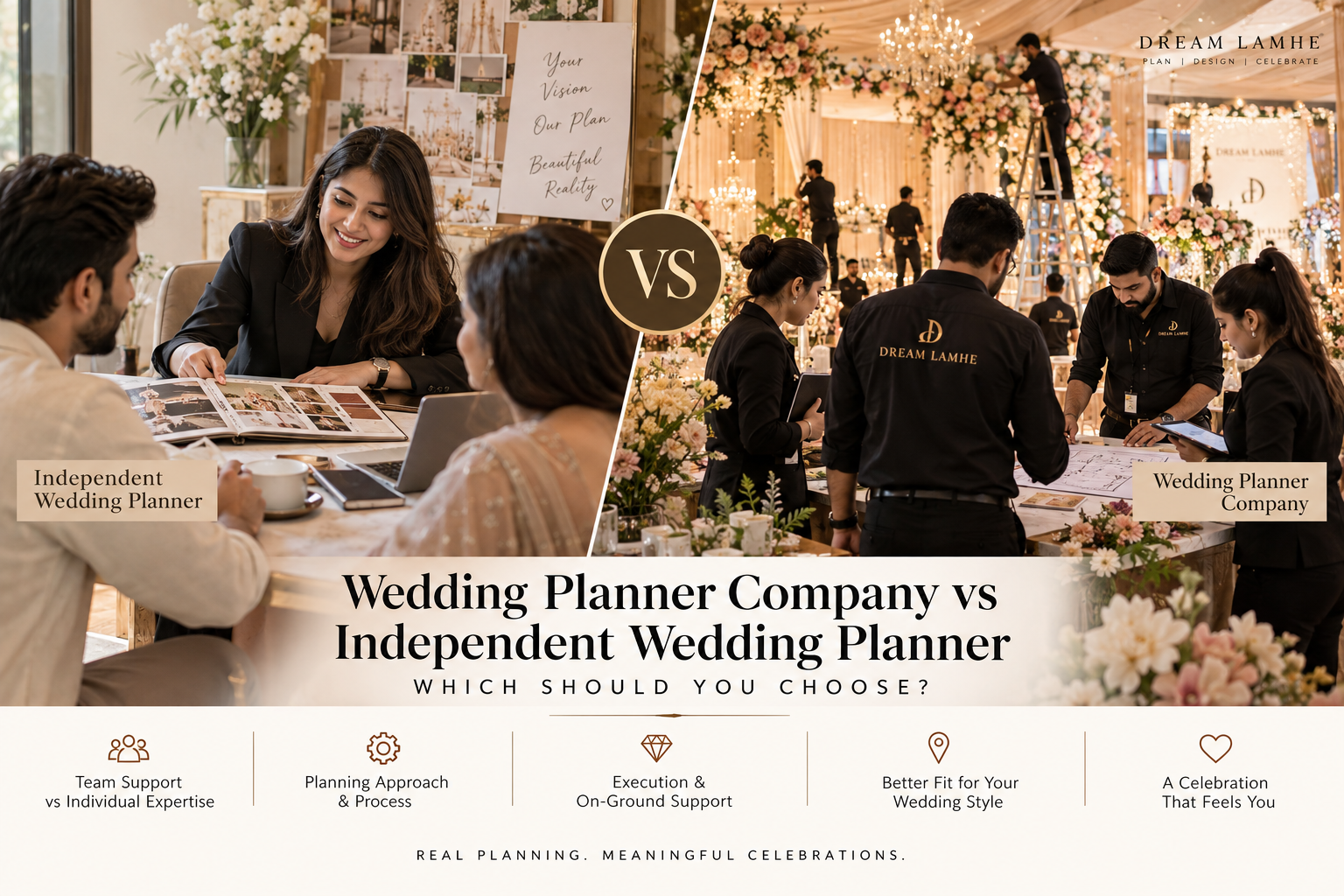
Planning a wedding often starts with a simple question:
“Who should we hire to help us manage everything?”
Then the options begin to appear — wedding planner companies, independent wedding planners, decorators, coordinators, venue teams and event managers.
At first, the difference may seem small. After all, both a wedding planner company and an independent wedding planner can help you organize your celebration.
But once the planning becomes real, the difference becomes much clearer.
A wedding is not just about selecting flowers, finalising a menu or choosing a beautiful venue. There are people to coordinate, timelines to build, vendors to brief, payments to track, guest requirements to manage and decisions to make when something does not go according to plan.
This becomes even more important when the celebration includes multiple functions, a large guest list, elaborate production or a destination venue.
So, should you work with a wedding planner company or an independent wedding planner?
The honest answer is: it depends on the wedding you are planning and the level of support you actually need.
Let’s look at the difference without the usual sales pitch.
What Is a Wedding Planner Company?
A wedding planner company is an organised planning business where the work is supported by a team rather than depending entirely on one individual.
The exact structure varies from company to company. Some specialise primarily in planning and coordination, while others may also have in-house or closely integrated design, production and hospitality capabilities.
A professional wedding planning company may coordinate areas such as:
Venue selection and coordination
Budget planning
Vendor sourcing and management
Wedding designing and décor
Guest hospitality
Accommodation coordination
Transportation
Photography and entertainment coordination
Event timelines
Wedding-day execution
Destination wedding logistics
The important distinction is not simply the word “company.”
A registered business with a beautiful website is not automatically better than an independent planner.
What matters is the people, process, experience, vendor relationships and execution capability behind the brand.
What Is an Independent Wedding Planner?
An independent wedding planner usually works directly with couples without operating through a larger planning team.
This can be a very good model for certain weddings.
An experienced independent planner may personally handle:
Planning consultations
Vendor recommendations
Budget discussions
Venue coordination
Event timelines
Décor coordination
Guest requirements
Wedding-day coordination
The biggest advantage is often the direct relationship.
You may speak to the same person who understands your preferences, attends your meetings and manages important decisions.
For a relatively intimate wedding with fewer moving parts, that can be exactly what you need.
The question is whether that individual has enough support when the wedding becomes operationally demanding.
Wedding Planner Company vs Independent Wedding Planner: What’s the Real Difference?
The simplest difference is this:
An independent planner is often centred around one professional. A wedding planner company is generally structured around a team and a system.
Neither model is automatically superior.
The right choice depends on the complexity of your celebration.
Factor | Wedding Planner Company | Independent Wedding Planner |
Primary relationship | Planner + planning team | Individual planner |
Team support | Usually available | Depends on the planner |
Multiple events | Easier to divide responsibilities | Depends on capacity |
Vendor coordination | Can be handled by multiple team members | Usually led by the planner |
Guest logistics | Can have dedicated support | Depends on the planner |
Destination wedding | Team resources can be useful | Depends on destination experience |
Personal attention | Team-based | Often highly personal |
Backup support | Potentially stronger | Depends on the individual |
Large guest count | Often easier to manage | Depends on capacity |
Smaller celebration | May be more structure than needed | Can be a good fit |
Complex production | Team structure can be advantageous | Depends on external support |
This table should not be treated as a rulebook.
There are excellent independent planners who can manage sophisticated weddings, and there are companies whose service may not justify their branding.
Always evaluate the actual team that will manage your wedding.
When an Independent Wedding Planner May Be the Better Choice
Hiring a company is not automatically the right decision.
An independent planner may be a better fit when your wedding is relatively simple and you value having one person closely involved throughout the planning process.
For example, you might consider an independent planner if:
You are planning an intimate wedding
If the guest list is manageable and there are only a few events, one experienced planner may be able to handle the requirements effectively.
You want one-to-one communication
Some couples prefer having one person who knows the entire story rather than communicating with several members of a planning team.
Your event has fewer moving parts
A single venue, limited number of functions and straightforward guest logistics may not require a large planning structure.
You have already selected several vendors
If much of the vendor selection has already been completed, you may primarily need coordination and execution support.
But there is one question you should ask:
“Who will actually be with us when the wedding is happening?”
If the answer is only the planner, find out whether they have assistants or trusted on-ground support.
A wedding does not stop needing attention simply because the planner is busy solving another problem.
When a Wedding Planner Company Makes More Sense
The equation changes when your wedding becomes larger or more complicated.
Imagine a three-day celebration involving:
Mehendi
Haldi
Sangeet
Wedding ceremony
Reception
Now add multiple venues, several décor setups, entertainment, catering, photography, transportation and guests arriving from different cities.
Suddenly, there are many things happening simultaneously.
This is where a wedding planner company can offer an operational advantage.
Multiple Functions Need Multiple Hands
During a multi-day Indian wedding, one team may be setting up a venue while another is coordinating guest arrivals and another is preparing the next event.
The advantage of a team is not that there are simply “more people.”
It is that responsibility can be divided without losing control of the overall plan.
One person can oversee the master timeline while others handle specific operational areas.
Vendor Management Is Where Planning Becomes Real
This is one of the biggest differences couples often discover only after planning begins.
Your wedding may involve:
Venue
Caterer
Decorator
Florist
Photographer
Videographer
Makeup artist
Mehendi artist
DJ or live entertainment
Choreographer
Transportation
Invitations
Production and technical teams
Each vendor has their own arrival time, requirements, payment schedule, setup needs and point of contact.
The planner’s job is not simply to introduce you to these vendors.
Someone needs to make sure everyone is working from the same event plan.
For example:
The photographer needs to know when family photographs are happening.
The decorator needs to complete setup before guest arrival.
The sound team needs to be ready before rehearsals.
The caterer needs to coordinate service timing with the event schedule.
The transportation team needs accurate guest movement information.
A strong planner creates the system that connects these moving parts.
That operational work is one of the less visible — but most important — parts of wedding management.
What About Wedding Designing?
This is another area where couples should understand the difference between planning and designing.
A wedding planner manages the overall process.
A wedding designer focuses more heavily on the visual experience — the theme, styling, décor, flowers, stage, lighting and atmosphere.
Some companies provide both services. Others work with separate designers and decorators.
Before hiring anyone, ask:
“Is wedding designing included in your planning service, or will I be hiring a separate décor team?”
This one question can prevent a lot of confusion later.
What Happens When Something Goes Wrong?
This is probably the most important question you can ask a planner.
Because something usually does.
A vendor may be late.
A setup may take longer than expected.
The weather may change.
A guest may need assistance.
An artist’s arrival may be delayed.
A ceremony may run behind schedule.
A family member may suddenly request a change.
The goal of professional wedding management is not to pretend that nothing will ever go wrong.
The goal is to solve problems without making them the couple’s problem.
On the wedding day, the planner or coordinator typically works from a detailed schedule or run sheet and manages vendor arrivals, transitions, guest movement and other operational requirements.
That’s why experience matters.
A beautiful portfolio tells you what a planner has created.
It doesn’t necessarily tell you how they behave when the plan changes.
Which Is Better for a Luxury Wedding?
Luxury does not simply mean expensive décor.
A luxury wedding is also about:
Thoughtful hospitality
Personalisation
Consistency
Attention to detail
Guest comfort
Seamless transitions
Professional execution
Design quality
If your wedding involves multiple functions, complex production, VIP guests, destination logistics or a large vendor network, a strong luxury wedding planner with adequate team support can make the planning process considerably more manageable.
But don’t choose a company simply because it uses words such as “luxury,” “premium” or “bespoke.”
Ask for evidence.
Look at previous weddings.
Understand what the team actually handled.
Ask who will be present on your wedding days.
And understand exactly what you are paying for.
What About Destination Weddings?
Destination weddings add another layer of logistics.
The couple isn’t only planning a celebration.
They are effectively coordinating a temporary experience for everyone travelling to it.
That can include:
Accommodation
Guest arrivals
Airport or railway transfers
Room allocation
Welcome experiences
Venue coordination
Local vendors
Multiple events
Transportation between events
Guest communication
Emergency requirements
For a destination wedding, ask the planner about their on-ground experience in that destination.
A planner who has successfully managed weddings in a particular city or venue environment may understand local vendors, venue restrictions, transportation realities and setup requirements better than someone entering the location for the first time.
Don’t Confuse a Venue Coordinator With Your Wedding Planner
This distinction is important.
Many venues have their own coordination team.
But the venue’s coordinator and your wedding planner do not necessarily have the same responsibilities.
The venue team is primarily responsible for the venue’s operations.
Your wedding planner is working on your overall wedding plan.
That can include coordinating several vendors, managing your timeline, communicating your preferences and ensuring the different parts of the celebration work together.
So if a venue says:
“We have an event coordinator.”
ask what that actually means.
Is that person managing the venue only?
Or are they managing your entire wedding?
Never assume the two roles are identical.
How Much Should You Focus on Price?
Price matters.
But comparing planners only by their quoted fee can be misleading.
Two planners may give you very different prices because they are providing different levels of involvement.
One quote may cover only coordination.
Another may include planning, vendor management, guest hospitality, design coordination and event-day execution.
Instead of asking:
“Who is cheaper?”
ask:
“What exactly am I getting for the fee?”
Compare:
Planning scope
Number of planning meetings
Vendor management
Event-day team
Number of coordinators
Guest management
Design involvement
Destination support
Travel requirements
Additional charges
Cancellation terms
Payment schedule
There is no single reliable “standard” wedding planner price that applies to every Indian wedding. Scope, location, guest count, number of functions and level of involvement can all change the commercial structure.
So be careful with articles that promise one fixed industry rate.
Questions to Ask Before Hiring a Wedding Planner Company
Before signing a contract, ask:
1. Who will manage my wedding?
Not just who is presenting the proposal.
Ask for the actual team structure.
2. Who will be present on the wedding days?
You want clarity before the first event begins.
3. How many weddings are you managing around my dates?
This helps you understand the team’s availability.
4. What exactly is included?
Get the scope in writing.
5. Who manages the vendors?
Clarify whether the planner coordinates vendors or simply recommends them.
6. Do you manage guest hospitality?
Especially important for destination and large weddings.
7. How do you handle last-minute changes?
Their answer can tell you a lot about their operating style.
8. What happens if the assigned planner is unavailable?
A professional business should have a clear answer.
9. Are there any additional charges?
Ask before signing rather than after the wedding is underway.
10. Can we speak to previous clients?
References can provide insight that a portfolio cannot.
Questions to Ask an Independent Wedding Planner
If you’re considering an independent planner, ask:
Will you personally be present at all functions?
Who will assist you?
How many weddings do you manage at the same time?
Who handles vendor coordination?
What happens if you become unavailable?
Do you have backup coordinators?
Have you managed weddings similar to ours?
Do you have destination wedding experience?
What is included in your fee?
Which responsibilities remain with us?
Again, this isn’t about finding a “better” business model.
It’s about finding a model that can realistically support your wedding.
So, Which One Should You Choose?
There is no universal winner.
An independent wedding planner may be right for you if:
Your wedding is relatively intimate
You have fewer functions
You want direct one-to-one communication
Your logistics are straightforward
You prefer a highly personal planning relationship
A wedding planner company may be the better fit if:
Your wedding involves several functions
You have a large guest list
You are planning a destination wedding
Multiple vendors need to be coordinated
Guest hospitality is important
Your celebration involves complex décor or production
You want a larger on-ground planning team
You need additional operational backup
And there is a third possibility:
You don’t necessarily need full-service planning.
If you’ve already handled most of the planning yourself, you may simply need a wedding coordinator or event-day management team to take over execution.
That can be a much more sensible choice than paying for services you don’t need.
The Better Question Isn’t “Company or Independent?”
The better question is:
“Who can realistically manage the wedding we are actually planning?”
Look beyond the logo.
Look beyond Instagram.
Look beyond the promise of a “stress-free wedding.”
Ask about the process.
Ask about the team.
Ask about vendor management.
Ask about event-day responsibilities.
Ask about what happens when the original plan changes.
Because wedding planning is not really about making a beautiful checklist.
It is about taking hundreds of individual decisions and turning them into one celebration that feels effortless to the people attending it.
And that is ultimately what you are hiring a planner for:
not just to plan the wedding, but to make sure the plan survives the real world.
How Dream Lamhe Approaches Wedding Planning
At Dream Lamhe, we believe wedding planning should begin with understanding the celebration you want to create — not with a fixed package or a generic checklist.
Every wedding has its own people, traditions, priorities and expectations.
Our approach is built around bringing those details together across planning, vendor coordination, event execution, guest experience and the overall visual direction of the celebration.
Whether you are planning an intimate celebration, a multi-day wedding or a destination wedding, the objective remains the same:
Your family should experience the celebration. Our team should be focused on managing the details behind it.
If you’re exploring wedding planning options, start with a conversation about your wedding, guest count, locations, events and expectations. From there, you can understand what level of planning and coordination actually makes sense for you.
Frequently Asked Questions
What is the difference between a wedding planner company and an independent wedding planner?
A wedding planner company usually works with a team that can manage different aspects of a celebration, including vendor coordination, wedding designing, guest management and event-day execution. An independent wedding planner generally manages the planning personally, sometimes with a small support team. The right choice depends on the size, location and complexity of your wedding.
Is a wedding planner company better than an independent wedding planner?
Not necessarily. The best choice depends on your requirements. An independent wedding planner can be a good fit for an intimate celebration that needs personalised attention, while a wedding planner company may be more suitable for a large, multi-day, luxury or destination wedding that requires several people to manage different responsibilities simultaneously.
How do I choose the best wedding planner for my celebration?
To find the best wedding planner, look beyond photographs and social media presence. Review their experience with weddings similar to yours, understand the services included, ask who will manage the wedding on the event days, check their approach to vendor coordination and guest management, and make sure the commercial terms are clearly documented before making a decision.
What should I look for in the best wedding planner company?
The best wedding planner company should have a clear planning process, experienced people, reliable vendor relationships and the ability to manage the practical details of your celebration. Ask about their team structure, previous work, wedding-day support, destination wedding experience, vendor management process, communication and what is included in their agreement.
Should I hire a wedding planner company for a luxury or destination wedding?
A wedding planner company can be a practical choice for a luxury or destination wedding when there are multiple events, a large guest list, several vendors and complex logistics to coordinate. However, experience matters more than the label. Before hiring, make sure the planner or company has successfully managed celebrations with a similar scale and level of complexity to yours.